


02 Jun A New Minksy Moment?
Shortly after the Great Financial Crisis, and as a result of its terrible impact, The Institute of New Economic Thinking was created. Thanks to it, economists could debate the reasons that took us to the recent recession and how to possibly avoid it in the future. Certain ideas from past economists were reconsidered and appreciated again. One of these economists was Hyman Minsky. He was a professor in Washington University in St. Louis, and was a marginal figure for his whole professional life until his death in 1996. Many of his ideas were credited to John M. Keynes, whose famous book “The General Theory of Employment, Interest and Money”, back in 1936 already refuted the idea of efficient markets. The Efficient Market Hypothesis remains the bedrock of how conventional wisdom views the financial system; it’s the premise upon which monetary policy is conducted and the framework used to construct financial risk systems. These days, nevertheless, many individuals involved in the financial markets recognize the importance of one hypothesis of Minsky: the so-called “Instability Financial Hypothesis”.
The main difference between the Efficient Market Hypothesis and Minsky’s Financial Instability Hypothesis comes down to the question of what makes the prices move within the financial markets. Efficient market theory states that markets are efficient; that is, all investors have access to the same information and they base their decisions on logic rather than emotion. As a result, asset prices are always and everywhere at the correct price. It is the laissez-fair of economics. Markets move naturally toward equilibrium, and remain so until influenced by a new, unexpected external event. On the contrary, Minsky’s Instability Hypothesis argues that financial markets can generate their own internal forces, causing waves of credit expansion and asset inflation followed by waves of credit contraction and asset deflation. Thus, the “Minsky Moment” describes the point at which a credit cycle suddenly turns from expansion to contraction.
So, Minsky’s greatest idea was to focus on leverage; the accumulation of debt relative to assets or income. In periods of economic stability, leverage increases because nobody believes he or she will have a problem giving back what it has borrowed. But in the long run, this rise in leverage will create economic instability, and in fact, generates what will become the next financial and economic crisis. Having high leverage obviously makes you vulnerable when things go awry. Why? Because an economic downturn leads many individuals who have borrowed money to adopt quick measures to decrease the debt burden. In order to do that, they can either liquidate the assets that they own and/or they can cut down spending and use a larger part of the income remaining to pay off debt. These measures may work, except when too many people and companies are doing it at the same time. As you can imagine, the collective effort constitutes their own defeat. If millions of property owners in trouble try to sell their homes at the same time to pay off their mortgages, home prices collapse, which suffocates a yet larger number of owners and leads to new forced sales. The same applies to other types of assets too, such as stocks.
Once the leverage in the economy is too high, anything can trigger the Minsky moment, whether a normal and simple recession, the burst of a housing bubble, rising interest rates, a very unlikely pandemic, the outbreak of war, uncontrolled inflation, etc.
We have already talked in previous posts about two very important asset classes: stocks and real estate. It is important to mention again that the financial markets must be fuelled by a wave of credit to fulfill the definition of a Minsky moment. We already delved into this here before, where we saw the most recent leveraged and speculative market in terms of Margin-to-GDP. As for the property market, we have also seen where we are very recently. Lately, the FED is trying to tame inflation with rises in interest rates. This should cause housing demand to decline, which in turn should push prices down and increase affordability. Could this, and most likely alongside other factors, trigger the next Minsky moment?
In this new post, we will consider other important economic metrics; we are going to see what the current situation is and compare it to the last two previous recessions.
Let’s have a quick look at some of the most important ratios:
Household Debt-to-GDP. This first ratio measures the total outstanding debt of households–commonly related to consumer loans and mortgages–to banks and other financial institutions as share of GDP. A high debt-to-GDP ratio is undesirable for a household, as a higher ratio indicates a higher difficulty to pay back its debts and, ultimately, a higher risk of default.
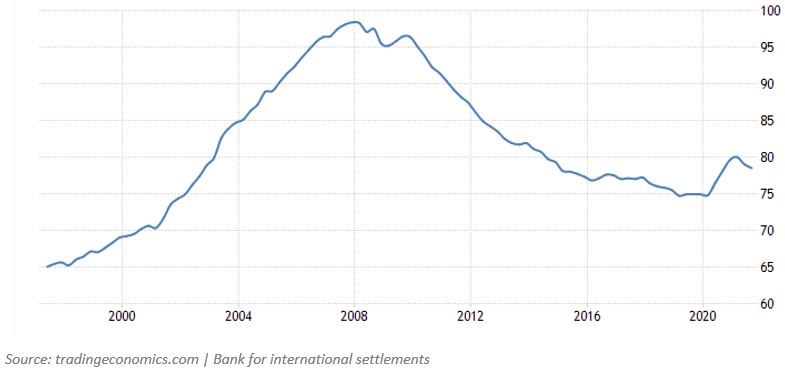
Although we cannot see it here in the graph, the ratio started at 60 per cent in 1990 and rose to 70 per cent in 2000, at the outset of the Dotcom bubble. We can now imagine how extreme the ratio was during the Great Financial Crisis, and what the consequences were. Now the ratio is lower indeed than 14 years ago, but rampant speculation and extreme monetary policy for many years have pushed capital away from safe assets. Instead, investors have been piling into real estate, stocks, NFTs, cryptocurrencies, and meme stocks. All this buying fuelled by larger than ever margin lending levels. Although the “slight” increase of 5% at the beginning of 2020 was probably a consequence of the nosedive the GDP took during the pandemic, it is still at a rather significant level.
Personal Savings Rate. This indicator is tightly linked to the household debt-to-GDP ratio. It always helps to have savings in the bank when a family is under serious financial constrain. It is simply much more delicate the situation of a family with no savings, that can’t pay off its debt, and it’s forced to sell any assets to cover expenses, than a family with a cushion to face such a financial emergency. As there are different cultures and policy measures applied around the world, this ratio changes from one country to another.
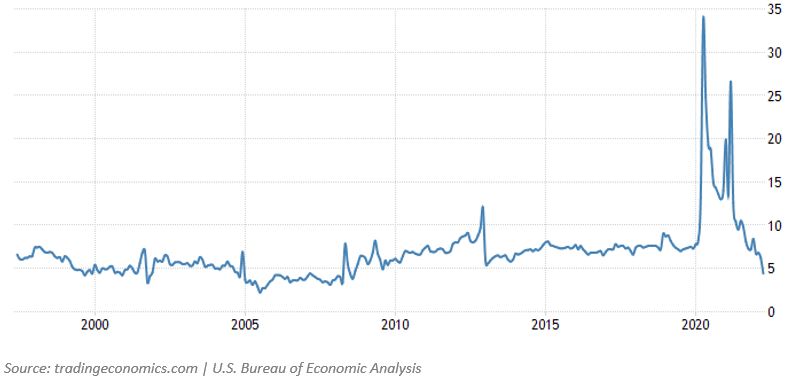
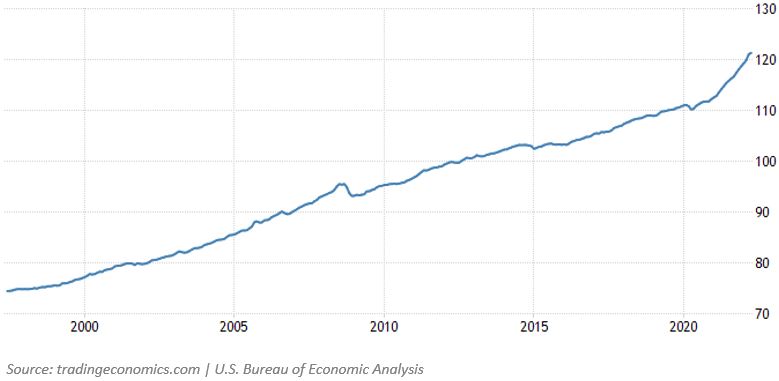
In the case of the United States, it has remained quite stable throughout history. Even further in the past, going back from 1958 to approximately 1987, the average was 11-12%. Moving forward, the average decreased to 9% until 1993, and even lower to a minimum of 3% right before the Great Recession. From them on, levels again stabilized around 6%. It was the pandemic, lockdowns, massive layoffs and huge uncertainty what caused the largest spike in savings rate ever seen. We are more recently headed toward levels seen before the GFC; currently in April at 4.40 per cent, from 6.20 per cent in March. The U.S. personal consumption expenditure price index, as we can see below has seen its more abrupt increase in the last two decades, probably heavily influenced by the inflation rate.
Lastly, Household debt service payments as a percent of disposable personal income. This ratio is the sum of two parts: the mortgage debt service ratio, and the consumer debt service ratio. It is used by lenders to determine the household’s capacity to cover the payments on loans and mortgages. In its simplest form, it is basically a measure of personal financial stability.
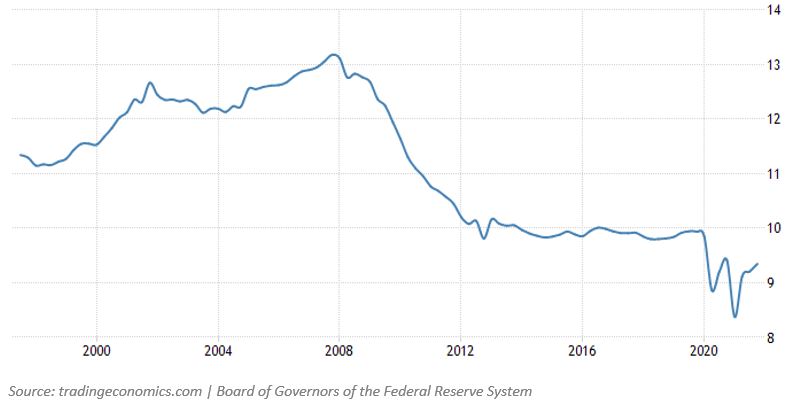
In this case, I believe we find the most benign of the cases revealed. It shows one of the lowest ratios in the last 25 years; meaning that households should not face as many troubles as before paying off their personal debt considering their income after taxes. This may be related to the Great Resignation and one of the lowest unemployment rates since the first half of the 1950s, which are leaving businesses with no other option than to offer higher salaries. Moreover, remote-working policies allow employees to work out of the city center, where it is easier to find more affordable rents.
In conclusion, this post alongside other previously mentioned, disclose the sensitive environment the markets seem to be in now. Any of the various fronts threatening the current economic situation may produce a cascade of worrisome events that may lead to financial instability and, ultimately, havoc in the markets. In my opinion, this next Minsky moment is coming in the very close future.