
20 Jun Market Situation, Part I
Many incumbents worry today about the current market conditions in the United Sstates: in which situation we are in, and the risks of a new downfall, especially compared to previous recessions. We will have a quick look here at different variables and find some a reference in time.
The first one it’s the famous “Buffett Yardstick”. It gives you a relative valuation of the total stock market value compared to the GDP of the country; or in other words, how much investors are paying for the final goods and services produced within the country. Thus, in times of overvaluation of stocks, this indicator stands at high levels, signalling that it might be a good time to sell your holdings or even open some short positions because a correction it’s more likely. On the contrary, in bad times, usually after recessions, the indicator reveals that stocks are, overall, undervalued, and may be a good opportunity to open long positions. According to Buffett’s comment at the end of 2001: “it’s probably the best single measure of where valuations stand at any given moment”. I will be using this illustrative chart straight from the website as it contains valuable insights.
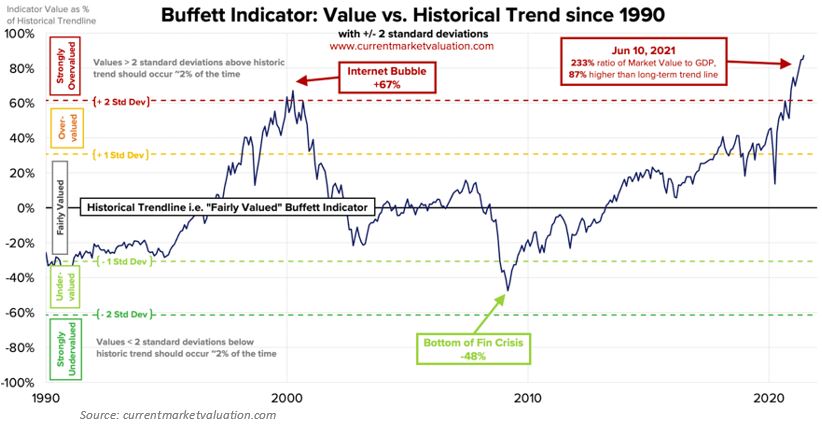
The situation is pretty clear, right? Current valuations are at the highest level in history. Investors keep buying shares of strongly overvalued stocks, stocks with prices above the previous 2001 Dotcom bubble, where investors simply stopped valuing businesses and just stuck to how the internet and other new technologies were going to completely change the world. Again, they lost track of fundamentals–definition of speculation–and just bought the narrative. Today, twenty years later, it seems not only that the market has lost memory, but also it is becoming a more aggressive buyer than before. Eventually, this will prove very costly.
The higher the price you pay for a stock, the lower the return you can expect from it. In general terms, it’s much harder for a stock price to go up when already has made a rally than after a bear market when it has so much room to grow. You are, therefore, assuming much more risk when you overpay. We can interpret the chart the same way, as the riskiest market in many decades. Why would you like to buy stocks when the promised return is so low, and the likelihood of a downfall is so high? Well, it seems there are many investors who don’t think the same. As incredible as it may sounds, not only they are willing to assume such high systemic risk, but they have decided to operate on margin more than ever before, increasing their risk even more. When a brokerage customer decides to trade on margin, he is basically borrowing part of his capital from the broker. To put it simply, it’s like coming to a bank to get a loan and buy–incredibly overpriced–stocks with that money. Who, in his right mind, would do that?
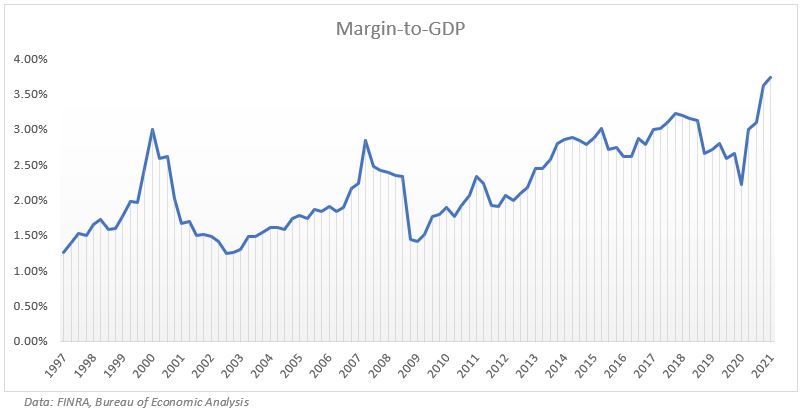
Apparently, there are increasingly more people doing that. This new chart provides a clear signal of rampant speculation. Albeit buying shares on margin are subject of certain requirements, balances keep rising. Beware that asset prices depend not only on money available, but on the capacity to borrow. There is greed in the streets and an optimism excess, which is the sign of an overheated market. These are far-from-equilibrium conditions. Many savvy investors know that prices are too high, so they are dumping their positions and selling to those willing to pay those prices. Remember Buffett’s quote: “Be greedy when others are fearful and fearful when others are greedy”. This may be the time to take a step back, gather information available, reflect on it, and decide not to follow the crowd but what intelligent investors are doing.