


30 May How does inflation impact securities?
“By a continuing process of inflation, government can confiscate, secretly and unobserved, an important part of the wealth of their citizens.”
– John Maynard Keynes
Some economists, analysts, journalists, and even market-savvies eager to give their two cents on Twitter have been recently warning about rising inflation in the United States. No wonder why. The government has expressed its will to create inflation, and in order to see it sprout, is flooding the economy with dollars. And it is not a metaphor. Quantitative Easing–once again–, a few stimulus checks to individuals, interest rates close to the zero bound to stimulate borrowing, and literally trillions of dollars for the repurchase program and the fiscal package. Moreover, in Main Street, businesses have been facing wage raises for a while and more recently even labor shortages, which creates supply chain issues and transportation bottlenecks. Ultimately, the customers are the ones paying for this, not only in terms of inconvenience, as they receive their orders much later, but also in higher prices.
Once inflation starts, it often persists. Government must be decisive and carry unpopular measures that aren’t normally well regarded by the population; for instance, cutting public spending to dampen growth or increase interest rates to cool down the overheated economy. Thus, such measures generally take place when inflation is too high to ignore anymore, and usually, much harder to fix.
As a brief recap, inflation is the pace at which prices of a representative basket of goods and services increase from period to period. This basket contains everyday products such as food, clothing, housing costs, transportation expenses, medical care costs, etcetera. This is the reason why inflation is usually measured by the consumer price index (CPI). We have used the word ‘increase’ in price because oppositely, a decrease would be named deflation.
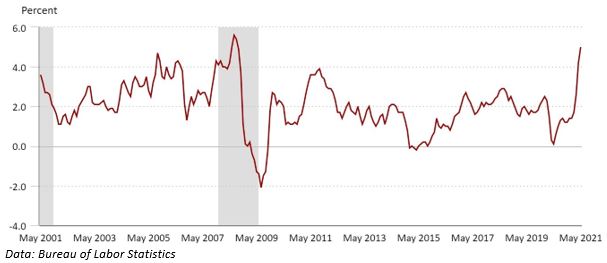
This phenomenon affects every citizen, whether he likes it or not. Whether you keep your savings in your bank account, your pension fund, or invested in securities. It will behave as a silent killer of your capital; a hacker that knows your bank account password and steals your money. Year over year. Consider it a tax, or consider him a theft, but better if you show some interest and learn how to react because it’s not going to stop.
In developed countries, such as those in Europe and North America, inflation has been considered mild and under control, ranging between 2 to 3% annually since 1980. Unfortunately, for some large economies, such as India, Brazil, China, and Russia, the story has been different. These have faced inflation at double digits for many years. And how does this inflation impact securities: bonds and stocks?
In the case of bonds, it is fairly simple. Most bonds pay a fixed interest rate annually for the life of the bond–hence the name “fixed income instrument”–until maturity, when the principal is given back. If the annual interest paid is 3% and inflation that year is at 4%, your investment is losing money. You are getting a 3% interest on your principal, but your everyday basket of goods and services is actually 4% more expensive. Your nominal gain from the bond is +3% (minus taxes), but in real terms, you are at -1%. Your investment is not keeping up with inflation.
For stocks, the computation is more complex, and important, especially in the case of a high-inflation scenario, where the impact on company valuations is much larger. That is why in countries with a history of high inflation, analysts spend a good deal of time trying to get the valuation right, whereas in countries with low and stable inflation, they often forget to include it in their analysis.
Companies have the ability to pass inflation costs on to customers. After all, if the price of those goods and services from the basket goes up, revenues of those firms must go up too, right? Well, it’s not that simple. In fact, a large body of academic research reveals that inflation is negatively correlated with stock market returns. Higher inflation = Lower profits. How can that be? Although they have the ability to do it, just a very few can pass on those costs. If you ever read “stocks are the best protection against inflation” better stop and think twice because it is not entirely true. Let’s illustrate with an example.
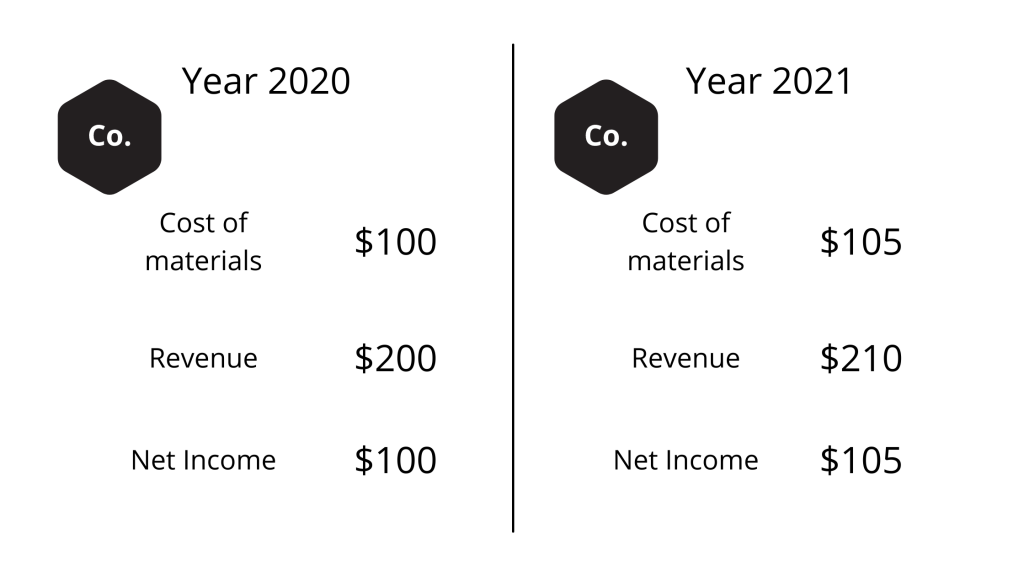
For the sake of simplicity, we will use an example with only three inputs: Cost of materials, Revenue, and Net Income. Or in other words, how much it costs to produce what the firm sells, how much it collects from what has been produced, and how much is left as a profit. As you can imagine, this is a very simple example; in real life, it becomes much more complicated when business units are in different locations around the globe managing a variety of currencies. That’s why we will assume that all is produced and sold in the same country, under the same currency. The time period is one year from today, and the inflation assumption is 5%. On the left-hand side column, we see that total cost is $100, revenue is $200 and net income is the difference, $100. In the next year, wages, costs of the materials to produce the goods sold, and rent go up by 5%. The firm, in order to counter this effect, decides to raise the price of its products by 5%, and customers happily pay the new difference without complaint, netting at the end an exact 5% increase in earnings. As a result of that decision, it has been able to keep up with inflation. But just in nominal terms, because despite seeing a rise of 5% in profits, in real terms it stagnated at 0% growth.
This example relies on a very strong assumption: customers are willing to stick with the product and pay the new price. Most of the companies see a drop in units sold when they increase prices. Or vice versa; that’s why in highly competitive industries firms engage in price wars to gather market share. This is related to price elasticity of demand. The more elastic, the more substantial the change in demand when the price is altered. Generally, when products are not–or perceived as not–very necessary or can be easily substituted, elasticity will be high, such as luxury goods. When consumers can’t find a similar product in the market, they will buy it regardless of the price, hence the inelasticity. For example, gasoline has very little price elasticity, because individual drivers will continue to buy as much as necessary to get to work, airlines to keep operating, etc. Another example could be personal computers, which have very elastic demand. As soon as any brand increases prices, potential buyers will look among the countless alternatives to find one with the same technical specifications for that same price. Therefore, sticking with a product, such as the one from our example, commands high loyalty. This is very uncommon and is only achievable by a very small percentage of the firms out there. And do you know which brand, which by the way builds computers too, has one of the highest customer loyalties out there? Exactly: Apple. They can do whatever they want, raise the price at or over inflation levels, and shoppers will stick with the product. But the truth is there are not many Apples out there.
Pushing up revenues is a function of not only raising prices but also selling more units. When investing under higher inflation expectations, look for companies that can adapt to an inflationary environment. They must have two characteristics: an ability to increase prices rather easily, and an ability to produce and sell more units with none or only a minor additional reinvestment. For example, businesses that require high tangible assets to operate are hurt the most. That’s because they require new assets to keep producing alongside reparation expenses. In other words: constant reinvestment. This is not the case for those able to generate revenue without the need of a bigger infrastructure, such as consultation firms, or those with a variable cost structure, such as Uber and Airbnb.
Another example of an excellent company that can do both things, or metaphorically speaking, can soak up inflation and not get wet, is American Express. A very well-regarded international enterprise whose primary revenue source is a fee that charges every time a member buys a product. They also generate revenue from annual memberships and credit cards’ interests. Most of these members are high-income earners, which means that they spend more often on expensive products, making the commission that they charge much larger. In addition, AE charges a higher percentage fee than its competitors. Rich people don’t usually reduce consumption during a recession, do they? From the business perspective, these rich individuals can afford to pay the new inflation-adjusted price of that pair of Louboutin, or the Tesla Model X, or those trips to Italy and Greece. Plus, American Express doesn’t incur much higher costs when they see their memberships soar, or when these members buy way more than before. It can easily absorb that higher customer demand.
Again, these are just a couple of examples of firms that can adapt to inflation. These are the exceptions, not the rules. The vast majority cannot increase prices enough to cover operating costs. Or cannot pass on the costs without losing volume. As a result, margins get squeezed, and they fail to maintain profitability in real terms. As mentioned above, high inflation affects the market negatively. For this reason, since 1980, the stock market lost money in eight of the 14 years in which inflation exceeded 6%. The average return for those years was a scanty 2.6%.
To reiterate, inflation leads to lower value creation. It wipes out your savings, eradicates bond returns, and affects stocks negatively. Only those businesses that can pass on inflation to customers can keep up, which are the least: those with the highest customer loyalty and very specific business nature. If economy observers are right, and high inflation is around the corner, take necessary actions to anticipate the impact. It will be well worth it.