


04 Mar The Bubble Triangle
«Over-investment and over-speculation are often important; but they would have far less serious results were they not conducted with borrowed money.»
– Irving Fisher
In recent posts I tried to explain the current situation the American stock exchange is in. Extreme company valuations by any historic standard and high leveraged retail investors are pushing stock prices to record highs. Today, we will apply a new benchmark and check whether the criteria used by the authors of a recent book align with the conclusion we have already reached.
These authors are William Quinn and John D. Turner, and the insightful book is Boom and Bust. In it, they leave aside the definition others suggest that, for an episode to constitute a bubble, prices must have become disconnected from the fundamental value of the asset. Instead, they propose a new metaphor and analytical framework, which describes their causes, and helps to explain the consequences.
The metaphor they use is to think of a financial bubble as a fire: tangible and destructive, self-perpetuating, and difficult to control once it begins. The formation of this fire–the bubble–is described in simple terms using what they call the fire triangle, which consists of oxygen, fuel and heat. When sufficient levels of these three components are present, a fire can be started real easily. And once it has begun, the removal of any of these components can extinguish it–despite, as they reveal in other part of the book, managing the bubble is much less important than managing its aftermath. They propose, therefore, an analogous structure to explain the formation of bubbles: the bubble triangle.
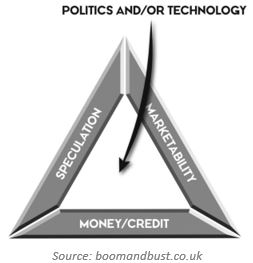
The first of the components mentioned, the oxygen for the boom, is marketability, which is the ease with which an asset can be freely bought and sold. Marketability is essential for an economy to function and that’s why is always present to some extent. It comprehends different dimensions: legality, like banning the trading of certain assets; divisibility, when is possible to buy only a small proportion of the asset; and the ease of finding a buyer or seller. When either of these dimensions increases, marketability increases as a result, and it’s easier for a bubble to form.
The fuel is money and credit. The presence of these two in the economy provides the public with sufficient capital to invest in assets, and makes the bubble more likely to occur. Two examples of this are low interest rates and loose credit conditions. For instance, low interest rates provide the public with a more comfortable opportunity to buy assets with borrowed money. In other worst cases, low interest rates on traditionally safe assets, such as government debt or bank deposits, can push investors to ‘reach for yield’ by investing in risky assets instead – they would often rather invest in something ridiculous than expect such a low return on the asset. Moreover, when banks lower lending standards, a larger number of people have access to money–and to a larger amount of money as well. The greater amount of funds to invest, the higher the price of assets will rise. That is why is always important to keep an eye on those lending standards not only when you own shares of a certain bank, but to check how much fuel has been dumped into the economy.
The third side of the triangle, the heat, is speculation. Speculation, for the authors of the book–since B. Graham differs from this definition–, is simply the Greater Fool Theory: purchasing an often already overvalued asset, and selling it later–often as soon as possible–to someone who will pay even more for it. Thus, this method does not consider the intrinsic value of the asset at all, but just the likelihood of someone out there with less knowledge, who is more impulsive, less rational, or as the name of the theory says, a greater fool. Speculation is also always present to some extent, as there are always amateur retail investors, or noise traders, with no knowledge regarding fundamental or technical analysis that operate in the market in the expectation of future price increases. These traders operate basically based on momentum. They do not believe that a trend will reverse, or if they do, they believe to be quick enough to get out of it in advance, and after turning a profit. During bubbles, a large number of novices interested individuals jump onto the market for easy profits. And just as a fire produces its own heat once it starts, speculative behaviour is self-perpetuating: as this segment of non-professional investors makes large profits, more public wants to join the party, which in turn results in further share price increases and further returns for them. This practice is commonly referred to as “riding the bubble”.
Now the question is, what is the spark that lay the fire? In the book, and as we can see on the top of the bubble triangle, the authors argue that it can come from two sources: technological innovation or government policy.
Technological innovation generates unusually large profits at firms that use the new technology. These profits cause share prices to rise, which attract the attention of speculators, which gradually pushes up prices even higher. Given that the technology is new, it brings a lot of excitement, which brings media attention and new investors. Furthermore, its economic impact is still uncertain. As a result, classic valuation metrics become markedly obsolete. There is no framework to determine what is considered an expensive share price, there is no roof, no top, and company valuations go sky high.
Alternatively, government policies can also cause asset prices to rise. This could be engineered deliberately in the pursuit of a particular goal, such as the enrichment of a politically important group, or the attempt to reshape some part of society–for instance, some housing bubbles were the product of the desire of the government to increase levels of home ownership. At the same time, governments can influence one or more sides of the bubble triangle as we have seen before; e.g., by lowering interest rates, or through financial deregulation.
I am sure that, by now, you might have been able to assign recent events or market conditions to different sides of the bubble triangle. Because we don’t want to be one who can’t see the forest for the trees, let’s quickly review some of them, and gather a broader picture of the current market situation.
Marketability: Nowadays you don’t even need a desktop to purchase shares. There are literally tens of broker apps available. You can just download one and open an account in a matter of minutes. Trading is more accessible than ever. Moreover, you don’t need $1,000 to invest in a company with a $1,000 stock price anymore. Many already feature the possibility of buying fractional shares, allowing us to invest in stocks for as little as $1. Free trading, frictionless apps, no minimum, and fractional shares have opened the door to buying and selling for everyone; or, what they call, the “democratization of investing”.
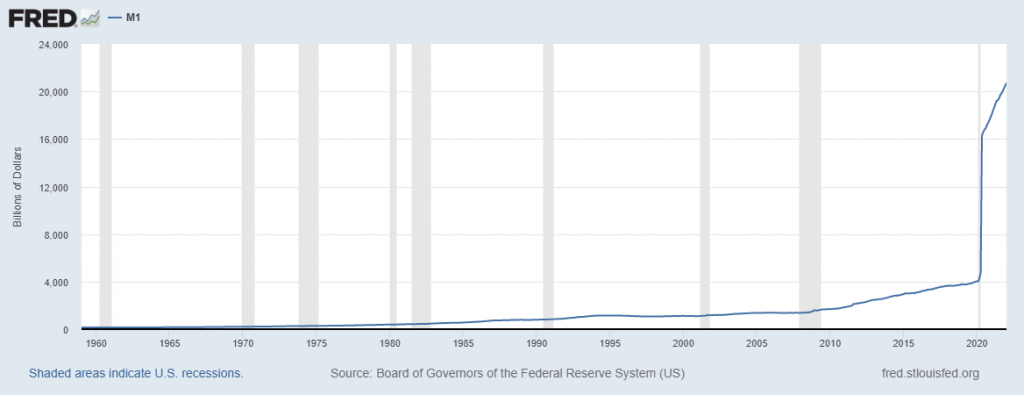
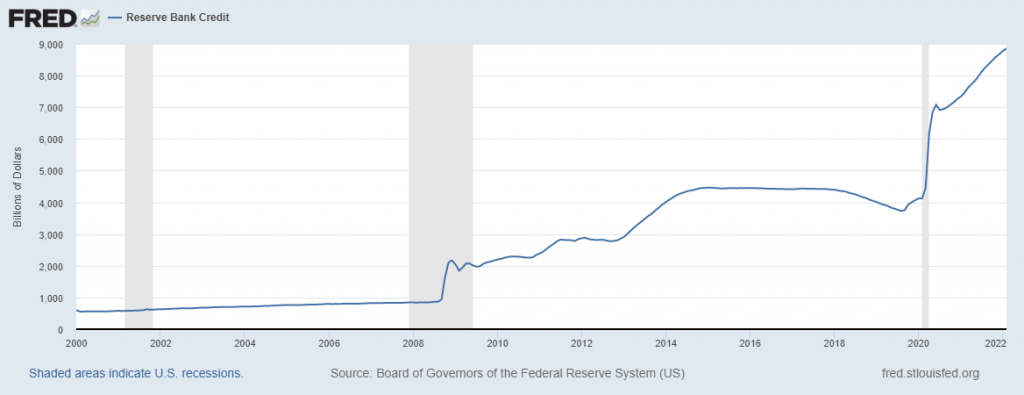
Money/Credit: Since the onset of the pandemic until December 2021, the FED run the QE program, buying roughly $8 trillion dollars along the way–$80 billion in treasuries and $40 billion in MBS each month. The consequence: not only devaluation of US dollars–over 80% of all US dollars in existence has been printed in the last two years–and the subsequent inflation we are now seeing, but a surge in the Fed’s balance sheet. In addition, the U.S. government has issued stimulus checks to millions of Americans. This resurgence of inflation is forcing the Fed to reconsider its monetary policy.
Speculation: Have we ever seen a more irrational market than this one? People are buying all sort of bizarre NFTs with the sole intention of selling them afterward at a higher price; “investing” in cryptocurrencies with no intention of knowing whether they are trading at their intrinsic value–if that’s even possible to determine–; we have lived the meme stonks mania, where a bunch of Reddit users were able to manipulate, or buy together and massively, short float stocks to push up prices and profit from it; and let us not forget about the YOLO call options, which means “you only live once”. Seriously, what kind of “investing strategy” do you expect to find in a trade with a name like that? As we have seen in a recent article, these retail investors have leveraged themselves to “invest” more than they can afford, pushing up the market and increasing the overall risk.
Technological innovation: We can see many innovations in almost every field, creating new revenue models that were not possible before, such as fintech, biotech, or healthtech, electric vehicles and batteries, green energy, virtual reality, metaverse, space rockets… The future is going to be exciting, but investors should still run fundamental analyses instead of buying in the hype when valuations are so high.
Government policies: Apart from the credit measures named before, the Federal Reserve Bank, in an effort to improve the pandemic-induced hardship on the economy, opened five facilities in total. The first three, the MMFF, the CPFF, the PDCF, were directed to ease frictions to those investors and corporations in the need of credit. The other two, the Primary and Secondary Market Corporate Credit Facility (PMCCF and SMCCF), made the Fed possible to buy bonds and provide loans. Additionally, other measures were implemented, both in the fiscal form, such as the Coronavirus Aid, Relief and Economy Security Act (CARES Act), and in monetary and macro-financial form, such as lower interest rates and lower community bank leverage.
There are, in my opinion, many components that fit perfectly within the bubble triangle. These authors provide precious insights that can help us predict bubbles. At the end, it all comes down to us being able to analyze market conditions and detect whether any spark can initiate a fire. Our duty is to act like fire-safety inspectors. We must stay vigilant, and protect our capital, especially, if we consider how easily the economy can burst into flames at any time.