


29 Mar Shark Tank’s Best Case Study
I have been recently rewatching old episodes of Shark Tank, generally while I am having dinner. And there was one, from the seventh season, that struck me, as the title of this blog post goes, as the most illustrative in terms of qualitative and quantitative analysis that I have found so far. Fortunately, the video is on YouTube, so I thought it could be a nice exercise to elaborate here a little more deeply on how the sharks are thinking about the pitch they are listening to and running the company numbers–valuation, growth, ratios, and the like. After all, they must have some kind of calculation that leads them to believe whether the business is good enough for them to invest in it or not. So here we go.
Jeff Overall, a young guy from California, pitches Polar Pro, a company he founded in 2011 that designs, manufactures, and sells a variety of innovative accessories, gear, and camera filters for GoPro cameras and drones. He is seeking a $500k investment for 10% in his company; that is, a company valuation of 5 million dollars. Although the number may seem high for some sharks, he is about to run the numbers and leave 4 out of the 5 investors very keen to become part of the company’s future.
Since the release of its first, most “simple” products, Polar Pro put real emphasis on increasing its product line. This is special to consider because, according to the bestselling book Valuation, not all growth is equally value-creating. As an example, for a general consumer company, it’s not the same to grow a company through an acquisition, an expansion in an existing market, an expansion in a growing market, or introducing new products. It is the last one of these types the best one to increase shareholder value for incremental unit of revenue. This statement may have some nuances, as it might be difficult for a cost-leader company to maintain unchallenged cost dominance when having a vast array of models and products, backward integration, highly automated facilities, assembly lines, etc. The most classic example of this is the assembly line technique of mass production that Henry Ford patented in the 1920s. A company with a larger variety of products will generally have, therefore, greater costs. However, in this case, being innovative and differentiated from most of the competitors pays out; he can charge higher prices and have, all in all, broader margins. So, as for what Polar Pro concerns, Jeff Overall technically took the good decision.
Then, he goes into these (gross) margins, which reveal how innovative and differentiated is in the market at that point in time. These margins range from 75% to 300%, which are certainly high for a company in such a competitive industry. Sales are increasing at an astonishing rate, going from $8k in the 2011 inception, to an expected 5.6 million dollars by the end of 2015. That’s a compounded average growth rate of 414% per annum! Truly impressive. So far so good. There is, though, a big caveat: profits, out of those 5.6M, will be around $300k, which leaves the profit margin at a tiny 5,35%, which is more common to find in consumer defensive products, such as basic needs, which are massed produced, and cost little to make. So, what is going on here? It turns out he is spending very heavily–over 20% of sales–on R&D in order to design, patent, and make new products, and stay ahead of the competition. Is this good or bad news? Well, a patent or some technological advancement is often a competitive advantage bestowed upon the company. But today’s competitive advantage may end up being threatened by substitute products or becoming tomorrow’s obsolescence. This type of company must constantly spend huge sums of money on R&D, especially when selling products are so attached to other constantly evolving products. This puts long-term economics at risk because upon patent’s expiration, the competitive advantage disappears, and margins automatically get crushed. The shark Mr. Wonderful is the first one to bring that up, and that’s the reason why he decides not to bid for the company any amount.
We can run some ratios at this point. Since the company has no debt and pays no interests as a result, it doesn’t really matter whether we use the equity value of the company or the whole enterprise value, which would include both the equity and the debt. We will start with the most popular ratio of all; the one that has been used for decades by popular investors in one way or another: the P/E ratio. This ratio is determined by dividing the price of the company by the earnings it generates. This gives investors an idea of how much bang they are getting for their buck. Since the price of the company has been set at $5 million, and earnings at the end of the fiscal period will be $300,000, the ratio is 16,67; or in other words, the price is 16,7 times the earnings. This can also be interpreted as the number of years you will need to gain back your initial investment. Is the ratio we just obtained high or low? Buffett likes it below 15, although that hasn’t stopped him from acquiring many companies when these were expected to grow a lot. In this case, and for a company that is growing so much, it’s certainly low because the denominator of the ratio will quickly increase in the upcoming years, reducing the time you will need to break even in your initial investment.
A useful ratio that we could use to count this growth effect in the formula would be the P/E-to-growth (PEG) ratio. For example, Polar Pro, with an expected growth of 75% next year would have a PEG ratio of 0,23.

However, the PEG ratio is often seriously deficient, especially in companies with very high or low growth, because it doesn’t take into consideration the ROIC, or the growth horizon is not clearly defined. In consequence, ratios can fluctuate quite a bit, and results can be confusing.
Another ratio commonly used for young companies when they have unstable or negative earnings is the Price-to-Sales ratio. But this is not the only condition under which we can use it. There are situations where companies are spending more on R&D or marketing than their peers, so their earnings are temporarily depressed. That’s the reason why Kenneth Fisher likes this ratio so much. In his 1984 book Super Stocks he explained that even the earnings of good companies can fluctuate greatly from year to year for a variety of reasons, such as equipment or facilities replacement, or changes in accounting methods. The solution to open up the investing opportunities was to look at this ratio. While earnings fluctuate, sales can be much more stable. He found, in fact, that revenues of what he called “super companies” rarely decline significantly. His rule was to avoid stocks with PS ratios greater than 1,5. On the other hand, businesses with ratios below 0,75 are to be bought aggressively. Finally, good values are to be found between PS of 0,75 and 1,5. Polar Pro, having a ratio of 1,12, it’s still within Fisher’s filter. So, one more reason to be excited about investing in there.
Now, it isn’t mentioned what the market size currently is at that moment, but Jeff says that the biggest selling item is the camera filters for drones, which also holds the largest market growth, and that the company, thanks mostly to this, could achieve in 2-3 years $40M-$50M in sales. According to Fortune Business Insights, the global commercial drone market is projected to grow from $1.915 million in 2020 and $2.317,2 million in 2021, to $11.295,1 million in 2028 at a CAGR of 25.39% in the forecast period. I’m also using the global market data because those retail pieces can be easily sold and delivered to customers worldwide. Polar Pro is also the third-largest drone aftermarket company, which leaves it well-positioned to keep growing at a large pace.
I have tried to represent what the income statement of the company could be in 2015 with the data we have available. It counts with several assumptions though, since we don’t know all the information available. Some data varies greatly from business to business, such as the Selling, General and Administrative (SG&A), Depreciation, and Tax percentage. The purpose of this is to simulate where the company currently is at and where can those numbers go, from the investment return of the sharks to the market size at present time. I am assuming a gross margin of 80%, an SG&A of 32.5% of revenues, and a depreciation of $1M – the typical forecast driver here is the prior PP&E, and although we don’t have the number, it’s being mentioned that Polar Pro produces everything in-house, so the number must not be small.
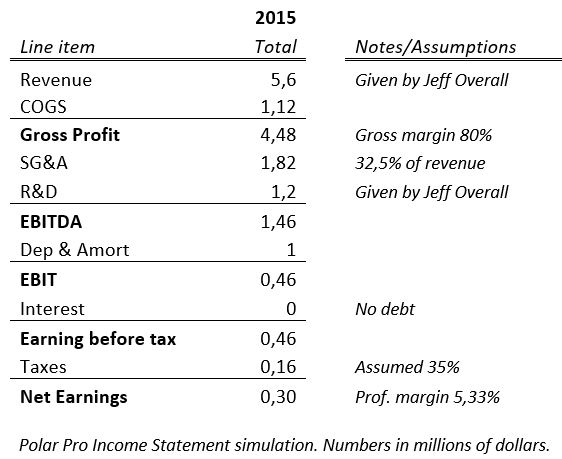
Now, based on this current simulated financial statement, we´ll be creating a forecast for the upcoming years until the last fiscal year–2021. In this next table, I will be assuming that revenue growth starts at 80% from the most recent year we have information about, and growth will be decreasing 5% per year. Considering that the actual annual compound rate has been over 400% since inception, and that market size is still expected to increase at 25% until 2028, I believe this number could have been in line with actual expectations. In fact, Jeff Overall expects to achieve $40M-$50M in sales in 3 years. In this example, it is reached in 4 years instead. Better to be conservative with the numbers just in case. Since the industry is rather competitive too, I decided to shrink gross margins by 5% yearly starting in 2016.
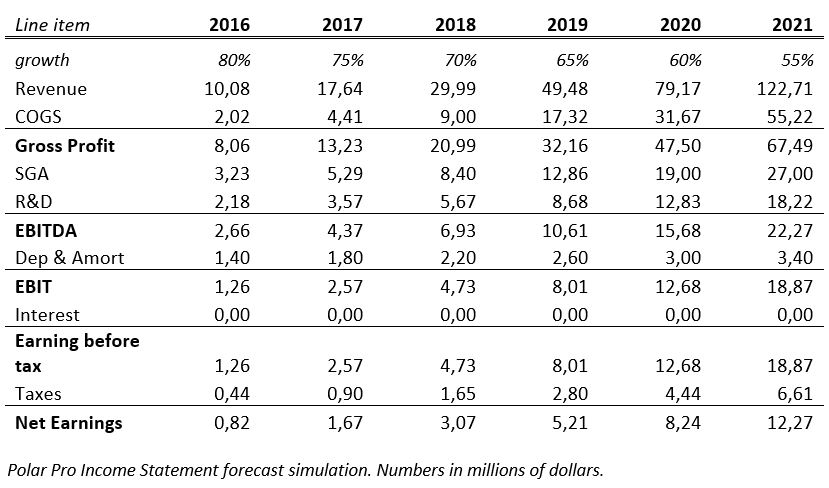
With all these numbers we can keep estimating how much the growth in earnings would be, how much the valuation of the company will increase, and the market size portion that Polar Pro will have captured by 2021, which is the most recent fiscal year forecasted. The valuations have been computed using the ratios obtained in 2015 previous mentioned: PE of 16.67 and PS of 1.12.
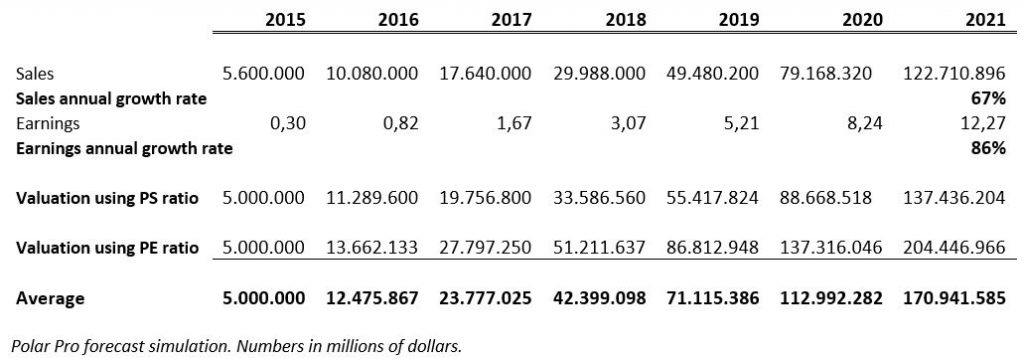
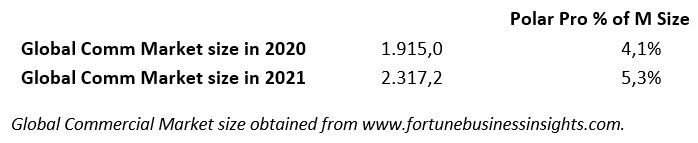
Jeff Overall bootstrapped the company with basically $2000. In his opinion, it’s worth in 2015 $5M. Sharks did not bargain with him, so they must see the valuation pretty fair. From $2k to $5M, being a single partner… that’s a great deal of value creation! Since the company has no debt, none of the profits is eaten up by interest expenses, and therefore, a larger portion is shared among the shareholders, which always excites new investors. Using our calculations, the company will grow at an outstanding percentage: from $5M, to almost $171M to present date. A total shareholder return of 3.319%, or a compounded annual growth rate of 80% for their investment.
There is still another important point to mention going back to the book Valuation that we did not go into detail because it’s a too broad of a topic: ROIC must always be higher than WACC–we can’t compute either of them because we know neither the overall invested capital nor the cost of capital at that time. Only when ROIC > WACC, the company must put the foot on the accelerator and focus on growth in order to create value. That’s why another shark, Robert Herjavec, said that he thinks he should grow much faster, and suggests accepting his proposal, combined with another shark, for a total of 1M to heavily support this growth. It is this offer the one Jeff Overall finally accepts.