


24 Ene Roblox and its future potential
The metaverse is one of the biggest megatrends now and is expected to become a part of everyone’s lives in one or two decades from now. Global metaverse market size was estimated at between USD 38.85– 63.83 billion in 2021 and is projected to grow at a compound annual growth rate (CAGR) of 39.4%-47.6% until 2030, with a total market size over 1,527.55 billion. The border between the virtual and real world will continue to break down and this new market, and all its subproducts and variations—virtual reality, augmented reality, and mixed reality—create one of the biggest investment opportunities of our time.
Roblox Corporation, one very recent public company in the sector—went public in 2021—is one of the best positioned to benefit from this rising trend. Started in 1989 as a 2D simulated physics lab used to simulate how, for example, two cars would crash, or how someone could build destructible houses. It was baptised as Roblox in 2004, with the intention of ushering a new category of human interaction. Categorized by the founders as “human co-experience” in millions of 3D digital worlds, users can play, learn, communicate, explore and expand their relationships. Although futuristics and science fiction authors have written about this for decades, it wasn’t feasible until now thanks to cloud computing, new powerful computing devices and high bandwidth internet connection.
Although Roblox has revealed negative earnings for the last three years, this is primarily due to the large expenses in research & development, payment to developers for content creation, and infrastructure. According to the most recent quarterly filing—third quarter of 2022—, the company expects to incur net losses in the near future, and many of these costs will stay high, both in absolute dollars and as a percentage of bookings as the business grows. Bookings represent the sales activity of the company, and are generated from the sale of virtual currency and subscriptions on the platform. Three of the operating metrics that the company uses are:
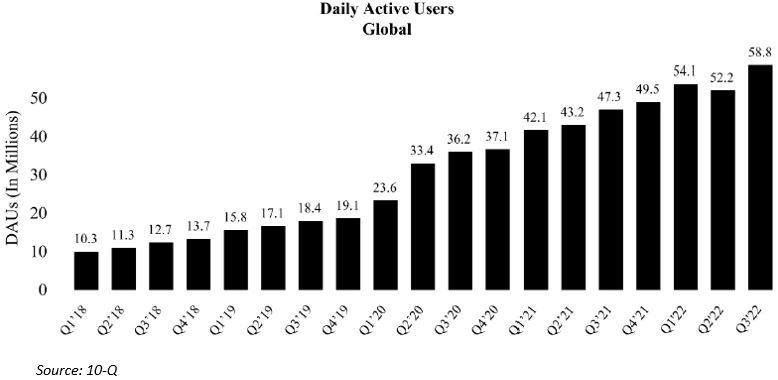
– Daily Active Users (DAU), which is an indicator of the size of the audience engaged on the platform. This number has been slowly but steadily increasing from the oldest published data, two years and a half ago, to the most recent quarter by a whole 471%. As we can see in the image below, Covid-19 acted as a potent catalyst.
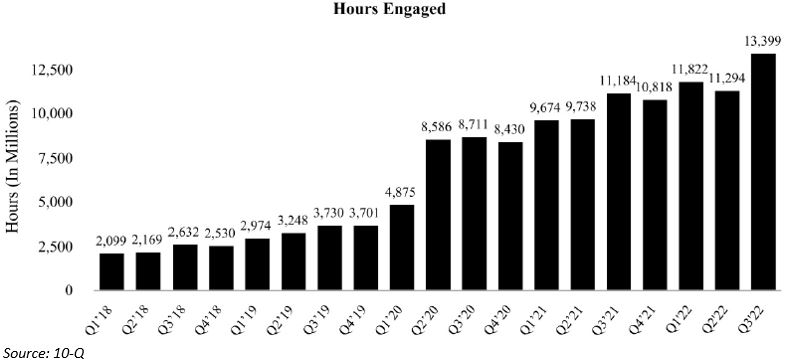
– Hours engaged. This is the time spent by the users on the platform. The company considers this an indicator of the value the users find in the platform. This number, also helped at some point by the pandemic, has also increased by 538% in two and a half years.
Whereas users spent in 2021 41.4 billion hours engaged on the platform, or an average of 2.49 hours per daily active user each day, users will spend approximately 49.4 billion hours; or an average of 2.42 hours per DAU each day.
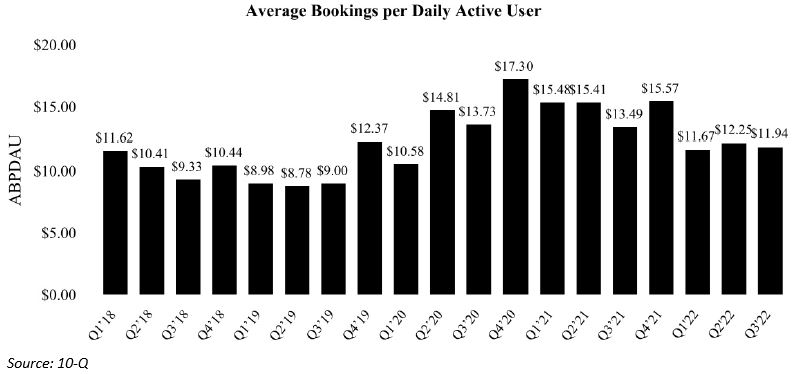
– Average bookings per daily active user (ABPDAU) describes the monetization capacity of the company through the sale of virtual currency (Robux) and subscriptions. This is where the numbers haven’t been, on average, as strong as during the Covid era. This is, in part, due to its international expansion. As per their company filing: “as we continue to expand internationally, including into developing countries where consumer discretionary spending is relatively weak, while our DAUs increase, the growth rate of our bookings could decelerate due to weaker spending by users from those regions, and our ABPDAU has been and may continue to be negatively impacted.”
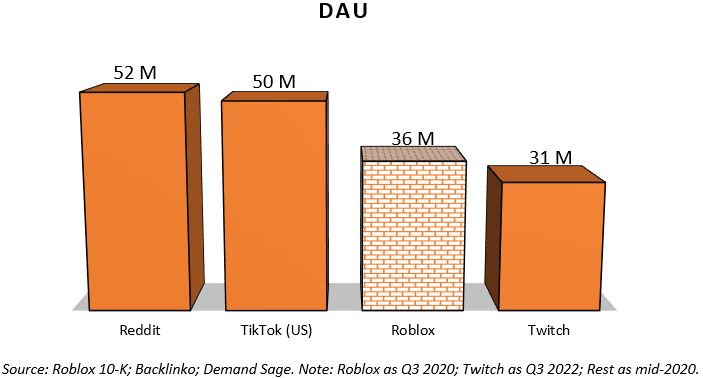
When we compare some of these metrics to some of the most engaging platforms, things get interesting. Regarding to daily active users (DAU), Roblox competes with the most important companies worldwide. Back in the second half of 2020 it already had more DAU than Twitch has today, and slightly less than Reddit worldwide or TikTok in the United States. As we can see in our first chart from before, Roblox’s DAU in the third quarter of 2022 was just shy of 60 million; that’s a 62,43% increase in two years.
But the most striking metric that we can find is its capacity to generate engagement. The stickiness that Roblox creates is the highest among the most powerful social media platforms out there by far.

Important to keep in mind: Roblox is predominantly a community of young users. By the end of 2021, 64% of the users were below 16 years old. This, in my opinion, is a source of hidden future strength of the company. As the company matures, and the games and experiences offered within the platform evolve to a higher quality content, older users, with much higher purchasing power, will join and spend more money than their younger siblings and cousins, with the sole authorization of their parents, will ever do.
However, what we need to look at to truly value the stock is its capacity to generate cash flow. And that is something Roblox does very well. Cash from operating activities is strongly positive, and what it’s left after subtracting CapEx is always positive. The company has stated that they intend to make significant investments to grow the business, including infrastructure and more acquisitions to add specialized employees, features, and technologies—it has completed 8 acquisitions since the beginning of 2021. For this reason, CapEx hit record numbers in 2022, and free cash flow has suffered. This should be for the best, though, as it should strengthen the operating cash flow and allow Roblox to keep funding future and larger investments.
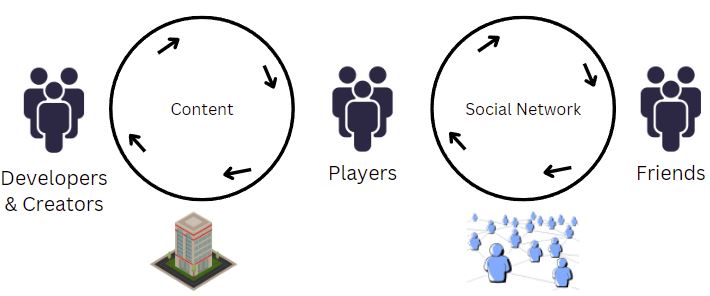
Growth at Roblox has been driven by not only significant investments but also two mutually reinforcing network effects: the creation of content –experiences and items that users can access—and social network. First, creators and developers build content, powering the platform. As they build increasingly high-quality content, more and more users are attracted to the platform. The more users interact in this 3D world, the higher the engagement and the more attractive it becomes to developers, who are encouraged to keep building and making money from the experiences they offer to the increasing number of users. Second, since the platform is social, when users join, they typically play with friends. This inspires them to invite more friends, driving organic growth—hence the low marketing expense compared to other popular platforms—and making the platform more valuable and engaging. This is a kind of product that ages in reverse; it gets more valuable with time and with additional users. Moreover, these two network effects, combined, create what Jim Collins named the flywheel. A flywheel is a business model that increases revenue or output without increasing inputs or costs.
Scalability is not at the moment crystal clear for Roblox. Developers can certainly make use of that power since each experience and item they create can be enjoyed by an unlimited number of users. The company can also sell as much virtual currency (bookings) and subscriptions as demanded; nonetheless, users spend those Robux on the experiences created by the developers, and is Roblox who then enables these developers to convert Robux back into real-world currency. In other words, the more experiences developers sell, the more Roblox needs to pay those developers. And as its financial reports state, management wants to increase these fees “in both absolute dollars and as a percentage of bookings over time as the business grows”. As a result, margins will remain as low as they are today. This low operating leverage, with higher variable costs than fixed costs, is good for younger businesses: they can benefit from lower risk because breakeven is easier to reach. This added flexibility in a start-up is of the utmost importance: lower risk equals cheaper financing, which they can use to keep growing.
However, escaping competition requires having effective scalability as an inherent part of the business. What could Roblox do to get there? This is the kind of situation Netflix was in until 2011. Still four years after Netflix started streaming, the company had to negotiate with content owners—film studios—for streaming rights. These rights were sliced and diced by geographical region, duration of the agreement, etc. All this was an important expense for the company. Netflix finally took what was, on the face of it, a risky counter-intuitive move: creating original made content and exclusive rights. That’s how House of Cards was born in 2012. Making their own content a major component of the company’s fixed structure, allowed them to finally enjoy scalability and expand margins. Any aspiring candidate to compete in terms of quality and costs had to ante up the same number of dollars, regardless of the number of subscribers they had. As the biggest streaming media service worldwide, it was a master move because no other company could spread out those fixed costs over such a large number of subscribers. This strategic decision enabled Netflix to enjoy economic profits for many years, and so did its investors – have a look at its stock performance since.
It’s not enough to simply create value – you also need to capture as much of that value as possible. Roblox is in a good position to keep capturing market share and growing, but at some point they will need to transition to a higher operating leverage business model, where the benefits can be immense. Creating high-quality exclusive content can be highly profitable when for any additional sale you don’t need to add an additional expense. Take as best example Microsoft, whose cost structure is primarily fixed and limited to its developers and marketing costs. As soon as they sell enough copies of its latest Windows software to break even, every additional dollar of revenue drops into the bottom line.
When analyzing a company, we need to ask ourselves this important question: will this business still be around a decade from now? A quantitative analysis won’t give you the answer, but the qualitative characteristics of it. While TV was the defining art form of the last 50 years, videogames may be the defining art form of the next half-century. And Roblox has strong foundations to enjoy lasting value for a long time.