


21 Dic Peloton’s Inventory Forecasted Troubles Ahead
Thanks to the reboot of “Sex and the City”, Peloton has been given recently a lot of publicity. Unfortunately for the company, not for good reasons. During a scene in the first episode–spoiler alert!–one of the most important characters of the series dies from a heart attack after taking a 45-minute class. The audience must have thought that exercising with Peloton’s products and following some classes it offers may be extremely dangerous to your health and, despite the company firing back with the short clip “He’s alive”, the event has caused a stock shake off in the open market. More bad news for its shareholders that have seen its stock price decline 72% to-day from its maximum back in January.
The company, which sells fitness products and subscriptions to live and on-demand classes, was clearly one of the large beneficiaries of the global pandemic. The stock price really took off when restrictive measures and lockdowns came into place. People were looking for new ways to train and stay fit at home, and the products offered fit perfectly those demands. What started as a 7 billion company after the IPO in September 2019 reached a peak of almost 47 billion at the beginning of 2021. Perhaps a valuation too high for a company that could not show a single year with positive net earnings. Being a tech company carries nowadays a very huge sex appeal, and investors are happy to provide them with cash hands over fist due to–incredibly–high expectations. Most of these expectations came in the form of products’ anticipation demand. Large profits were expected as a result of these large incoming revenues, but instead, the story has been different so far. Alongside large sales, instead of margins at the same level or slightly opening, what we see is the exact opposite. Margins have decreased dramatically and, as a result, negative earnings have increased at the bottom of the income statement. It seems it has been hard to deal with so much success.
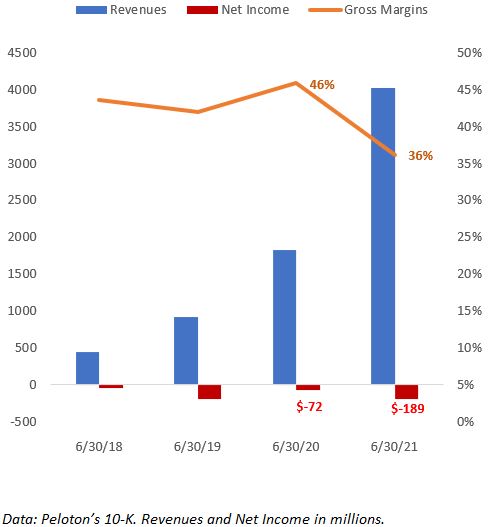
Despite extreme previous valuation and end of lockdown restrictions, I strongly believe investors could have anticipated this fall if they had just looked at the most recent financial statements. The problem was there for us all to see. Right in the balance sheet.
Thornton L. O’Glove’s wonderful book “Quality of Earnings”, provides us with clues to find red flags. In his own words: “[…], higher trending inventories in relation to sales can lead to inventory markdowns, write-offs, etc. In addition, it is important to note that an excess of inventories, time and time again, is a good indicator of true slowdown in production.” This example is especially true in the case of high-tech products. Manufacturing companies have often larger inventories, as a ratio to sales than service companies, but as mentioned before, Peloton is not a pure manufacturing company; they possess an interesting type of recurring revenue with high margins: subscriptions, which accounts for 21.7% of annual revenue. However, the other roughly 80% comes from selling physical products, so it is of the utmost importance to handle inventories correctly. It is also important to analyze the components of inventory. An increase in raw materials usually means business is speeding up, company is stocking up to face demand, and positive earnings should lie ahead. Inventory should grow commensurately with demand, but this is not what we see when looking at the annual results.
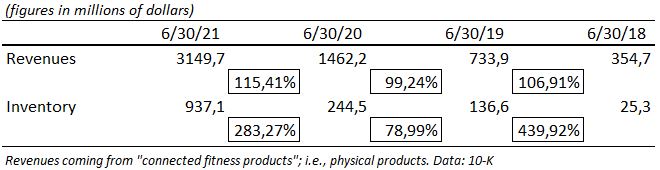
Looking back at the last 3 years, revenues have increased 4.29 times from end of June 2019 to end of June 2021, whereas inventories have increased almost 7 times. But when we look back even further, we can see that while revenues have increased 8.9 times from end of June 2018 to end of June 2021, inventories have increased… 37 times!
Let´s now zoom in and see the quarterly results, alongside a breakdown of the inventory items, which will be very illustrative.
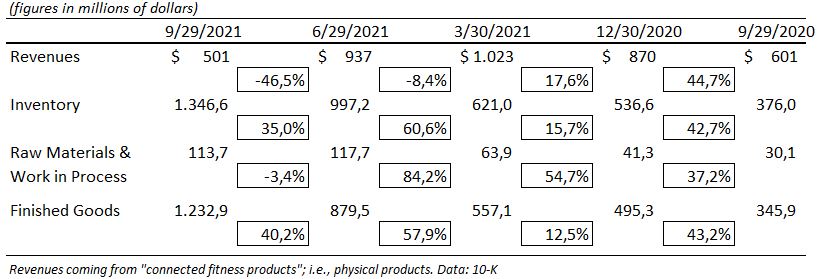
In the first two quarters exposed in our table, we see indeed how inventory advanced commensurately with revenues. It was in the last fiscal quarter when things started going awry. Company revenues declined while inventory increased more than ever. In the breakdown, we see a large increase in raw material & work in progress, which should have made sense if the company was receiving many orders. In fact, the opposite happened, they were receiving fewer orders than before, but they bought more raw materials than ever. Peloton, in the next quarter, seemed to realize that by lowering orders of raw materials. Too late; there was a huge divergence between the already negative revenue growth and finished goods. This effect where raw materials and work in progress components decline, and finished goods substantially increase is known as “negative inventory divergence”, and as you can imagine is a bad omen for financial results: they repeatedly forecast downward earnings.
Now the company found itself with a huge amount of stock ready to be sold with no demand. What can the company do about it? In high tech markets like these, technologies develop very fast, and I&D expense is usually large. If the company keeps spending on innovation across their product lines as the CEO John Fowley said will do and as the expense in I&D reveals, those finished goods may be seen unattractive, and the only way to push them out to market would be through severe markdowns, which would directly impact the income account. This has already been happening; we have seen this year the second price cut that has taken the price of its original Peloton Bike from $2,245 to $1,495 now. They announced this at the end of August, and as you can see from the table, the company also saw what was already happening. We did not have access to the results of that quarter yet, but we could have seen it when the 10-k was released for the fiscal year on August 27, and we could have acted accordingly. It was the week of September 10 when the market cap saw its latest peak, so we still had over two weeks to react. The situation, as a matter of fact, only got worse the next quarter. Furthermore, new monthly financing options have become coincidentally now available for some of its products, which will increase its accounts receivables and decrease their cash on hand available. We could also expect ramping expenses in intense sales campaigns, as we see below.
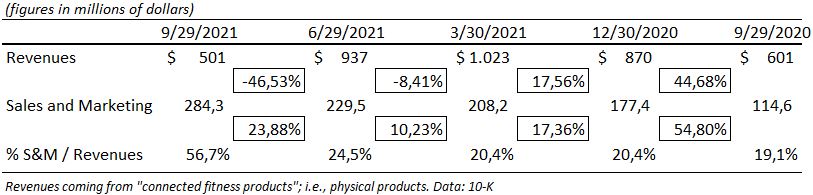
All this – larger expenses on I&D, on marketing, price cuts, financing options, looser covid restrictions, gyms opening again, etc. – will definitely affect future operating results. No wonder why Wall Street is expecting flat earnings growth by the end of this fiscal year. In my opinion, it isn’t crazy to think about negative growth in the years ahead. How likely is it that they can sell as much or more than they were selling during a worldwide lockdown with gyms closed?
Oh, and along the way, they issued 1.7 billion dollars equity between 2019 and 2020, over $1 billion a month ago, and roughly another billion of debt during fiscal year 2020-2021. As we have seen, not only all that cash has been unskilfully allocated, but the company has ended up more indebted, and existing shareholders have seen their ownership diluted considerably.
Peloton might have missed its one in a lifetime opportunity. A new opportunity may also arise with this lower valuation in the form of an acquisition – perhaps from Apple or Nike? – which could still reward shareholders. But everything is not lost; it could press the reset button and go back to basics. It could de-escalate and try to find a profitable stable situation doing things right, starting with manufacturing prowess. Any sort of Power that the company may have starts with operational excellence. This management has still a lot to prove.